
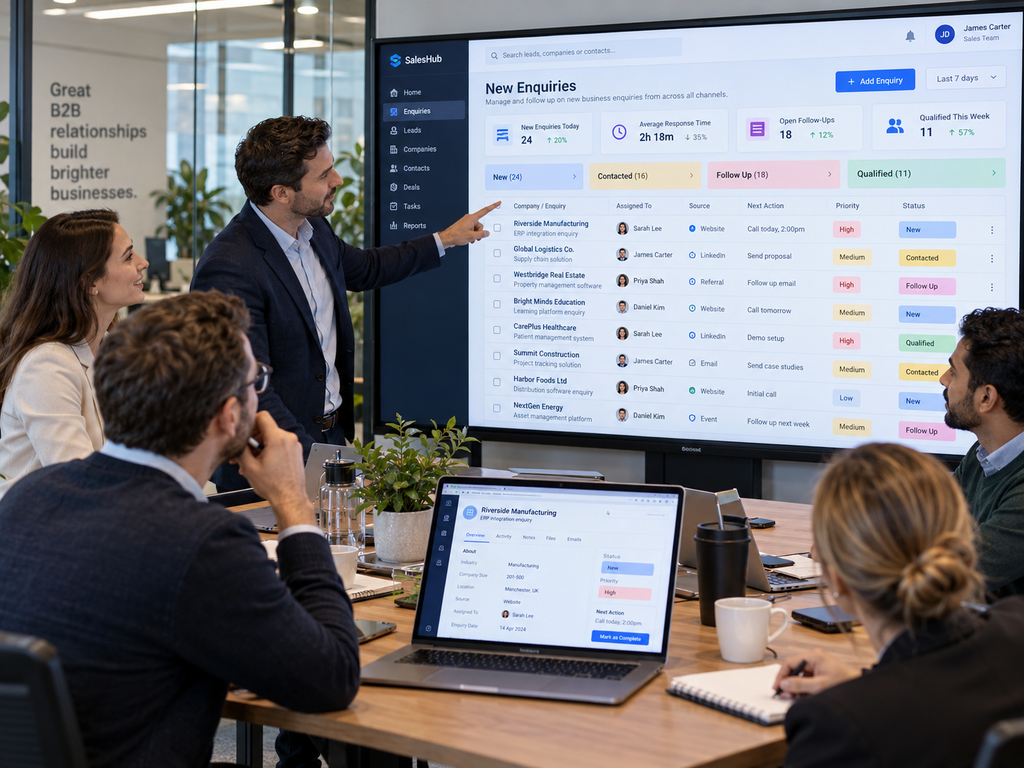
Generating leads is only the beginning. What happens after a potential customer makes an enquiry can determine whether that interest develops into a meaningful sales conversation or disappears into an unmanaged pipeline.
Your business receives a new enquiry.
Someone fills out a website form, requests a quotation, sends a WhatsApp message, or responds to a marketing campaign.
The lead enters your system.
What happens next?
Does the prospect receive an acknowledgement? Does anyone check what the company actually needs? Is the enquiry assigned to a salesperson? Is there a clear follow-up plan?
Or does the lead simply become another name in a spreadsheet, CRM, or overflowing inbox?
For many businesses, the challenge is not necessarily generating more leads. It is creating a reliable process for managing the enquiries they already receive.
This is where a well-designed B2B lead follow-up workflow becomes essential.
But effective follow-up does not mean sending seven emails, making five calls, or contacting every prospect across multiple channels.
It means creating a structured process that ensures every relevant enquiry is understood, assigned, handled appropriately, and moved towards a clear next step.
Here are seven practical steps for building a more accountable sales follow-up system.
1. Acknowledge the Enquiry and Set Clear Expectations
The first step is to let the prospect know their request has been received.
Whether the enquiry arrives through your website, email, WhatsApp, or another approved channel, a timely acknowledgement can help establish confidence.
A useful acknowledgement should be simple and relevant.
For example:
“Thank you for contacting us. We’ve received your enquiry about our services. Our team will review your request and contact you through the appropriate channel regarding the next steps.”
The message should confirm receipt without making promises the business cannot reliably fulfil.
If your team cannot guarantee a response within a particular period, avoid advertising that timeline.
Where appropriate, automated acknowledgements can help maintain consistency, especially when enquiries arrive outside normal working hours.
However, the communication must follow applicable consent, privacy, and channel requirements.
The objective is not to start selling immediately. It is to establish that the enquiry has entered a responsible process.
2. Understand the Prospect Before Starting the Conversation
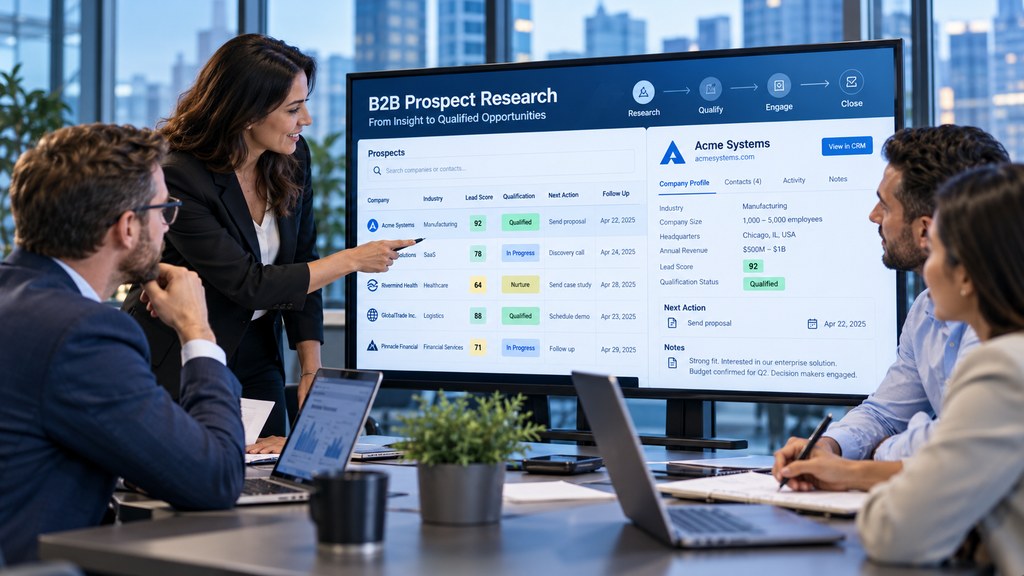
A new lead is not automatically a qualified opportunity.
Before sending a detailed pitch, your team should understand who made the enquiry and why the business may need your services.
This may involve reviewing the information submitted by the prospect and checking appropriate, publicly available business sources.
Relevant information could include:
- Company name and industry.
- Products or services the business provides.
- The specific enquiry or expressed business need.
- The source of the enquiry.
- Relevant company information that helps prepare a useful response.
For example, a business enquiring about CRM implementation may need help managing sales opportunities across several teams.
But that need should be confirmed through conversation, not assumed simply because the company operates in multiple locations.
AI-assisted research may help organise available information, but important facts should be verified before they influence outreach.
Businesses should also avoid collecting unnecessary personal information or making speculative judgments about prospects.
Good lead qualification starts with understanding the business problem, not guessing what the prospect wants to buy.
3. Plan the Right Follow-Up Based on the Prospect’s Response
Once the enquiry has been acknowledged and reviewed, the next step is to determine whether further contact is required.
Not every lead should enter the same follow-up sequence.
A prospect requesting a product demonstration may need scheduling support.
Someone asking for general information may need a relevant explanation or brochure.
A buyer already speaking with a salesperson may require a direct, personalised response rather than another automated marketing message.
A useful lead follow-up workflow responds to what the prospect actually does.
For example:
If the prospect replies: Review the response and determine the appropriate next action.
If a meeting is booked: Confirm the appointment and stop unnecessary scheduling reminders.
If the enquiry remains unresolved: Create a suitable follow-up action based on the agreed process and communication permissions.
If the prospect declines or opts out: Respect the decision and stop the relevant marketing outreach.
This conditional approach makes follow-up more relevant and less intrusive.
Effective sales automation should respond to customer behaviour, not simply execute a fixed number of messages.
4. Create or Update the CRM Record
A customer enquiry should not depend on one employee’s memory, inbox, or personal spreadsheet.
Once the enquiry has been received, the relevant information should be captured in the organisation’s agreed system of record.
For many businesses, this will be a Customer Relationship Management (CRM) platform.
A useful CRM record may include the company name, enquiry source, expressed need, assigned owner, communication preferences, interaction history, and next action.
Before creating a new record, the workflow should check whether the prospect already exists in the system.
Duplicate records can create confusion, conflicting ownership, repeated messages, and unreliable reporting.
CRM updates should also reflect meaningful changes in the conversation.
If a prospect books a meeting, the record should show the booking.
If an opportunity is disqualified, the status should reflect the decision.
If the lead requires technical support, the relevant information should be available to the responsible team.
A CRM is valuable when it helps people coordinate customer relationships, not when it merely stores contact details.
5. Assign a Clear Owner and Next Action
One of the biggest causes of missed sales opportunities is unclear responsibility.
A lead may exist in the CRM, but nobody knows who should contact the prospect.
Or a salesperson may be assigned without a clear deadline or specific next step.
To avoid this, every active enquiry should have a defined owner and an appropriate action.
For example:
Lead: ABC Manufacturing Ltd.
Enquiry: Inventory management solution.
Assigned owner: Business Development Executive.
Next action: Review the requirements and contact the prospect through the permitted channel.
Due date: Within the company’s agreed response window.
This level of clarity makes follow-up measurable and easier to manage.
It also helps managers identify enquiries that are waiting too long for attention.
Where automated task creation is available, the system can help assign work and notify employees of upcoming responsibilities.
However, creating a call task does not mean an automated call should be placed without appropriate authorisation.
Automation should make responsibility visible. It should not remove the judgment needed to handle a customer relationship properly.
6. Use Relevant Lead Nurturing Instead of Repetitive Messaging
Not every prospect is ready to make a buying decision immediately.
Some businesses need more information. Others are evaluating budgets, discussing requirements internally, or comparing possible solutions.
A relevant lead nurturing process can help maintain communication without overwhelming the prospect.
Depending on the enquiry, useful content might include an implementation checklist, service overview, practical industry guide, or invitation to a relevant discussion.
For example, a prospect exploring ERP software may benefit from an ERP readiness guide.
A company researching CRM automation may find a lead management checklist useful.
The content should support the prospect’s expressed interests and current stage of consideration.
It should not simply repeat the same sales pitch through email, WhatsApp, and LinkedIn.
Nurturing should also stop or change when the prospect replies, books a meeting, opts out, or enters an active sales conversation.
Businesses should apply appropriate communication permissions and suppression rules throughout the process.
Good nurturing helps prospects make informed decisions. Poor nurturing turns every interaction into another sales interruption.
7. Alert the Right Salesperson When Human Attention Is Needed
Automation can acknowledge requests, organise records, create tasks, and support follow-up activity.
But some situations require direct human attention.
A prospect may request a proposal, confirm a meeting, ask a technical question, or raise an issue beyond the automated workflow’s scope.
When predefined conditions are met, the system should alert the responsible employee.
For example, a workflow might trigger an internal notification when:
- A prospect requests a commercial proposal.
- A qualification review identifies a potential sales opportunity.
- An important customer question requires specialist support.
- An enquiry remains unassigned beyond an agreed threshold.
- A CRM update fails and requires manual intervention.
The alert should make the reason for attention clear and identify the action required.
However, an alert should not automatically be treated as a qualified opportunity or completed sale.
The salesperson remains responsible for assessing the situation and deciding how to proceed.
The purpose of an alert is to bring the right person into the conversation at the right moment.
What Does a Seven-Step B2B Lead Workflow Look Like?
A well-designed lead workflow combines customer-facing communication with internal activities.
| Step | Activity | Expected outcome |
|---|---|---|
| 1 | Acknowledge enquiry | Prospect knows the request was received |
| 2 | Review company context | Relevant business information is available |
| 3 | Determine follow-up route | Next communication matches the prospect’s status |
| 4 | Create or update CRM | Enquiry information is recorded accurately |
| 5 | Assign owner and task | Responsibility and deadlines are clear |
| 6 | Apply relevant nurturing | Appropriate information is shared when permitted |
| 7 | Trigger internal alerts | Human intervention happens when needed |
These are seven workflow controls, not seven compulsory customer messages.
The steps also do not always happen in a rigid sequence. CRM creation and ownership assignment may happen immediately, while follow-up and nurturing depend on subsequent activity.
The system should adapt to the enquiry rather than force every prospect through identical actions.
Build Stop Rules Into Your Sales Automation
One of the most overlooked elements of sales automation is knowing when the system should stop.
Without clear stop conditions, automated workflows can continue sending messages after a prospect has already replied, booked a meeting, or declined further contact.
This creates frustration and can weaken confidence in your business.
A controlled workflow should define what happens when a prospect opts out, a meeting is confirmed, a duplicate record is detected, an opportunity is disqualified, or an automated action fails.
For example, if a prospect has already booked a consultation, the system should cancel unnecessary meeting-request messages.
If the prospect withdraws permission for marketing contact, that preference should be reflected in the appropriate records and communication processes.
If an integration fails while updating the CRM, the issue should be logged and made visible to someone who can recover the enquiry.
A reliable workflow is not just designed to operate when everything goes right. It must also handle exceptions safely.
Test the Workflow Before Automating More Leads
Before deploying a lead workflow across every campaign and communication channel, test it with a small number of fictional prospects and controlled scenarios.
Check whether enquiries are acknowledged appropriately, existing CRM records are recognised, ownership rules work correctly, and follow-up tasks are created as expected.
Test what happens when a prospect replies, books a meeting, opts out, or submits a duplicate enquiry.
Confirm that failed updates produce visible exceptions rather than silently losing information.
Once the process operates reliably, review its performance using measures such as response handling, CRM completeness, overdue actions, accepted opportunities, and customer complaints.
A small, carefully evaluated workflow is often more useful than a complicated automation system nobody fully understands.
Final Thoughts: Every Lead Needs a Process, Not Just Another Message
Businesses often invest heavily in advertising, lead generation, and outreach tools while paying less attention to what happens after an enquiry arrives.
Yet the handoff between marketing, sales, CRM, and customer communication is where important opportunities can be lost.
A structured B2B lead follow-up workflow helps create consistency without removing the human judgment required for effective selling.
It ensures that enquiries are acknowledged, relevant information is captured, responsibility is assigned, follow-ups are appropriate, and exceptions receive attention.
The goal is not to automate every interaction.
The goal is to create a sales process where every relevant lead has a clear owner, a meaningful next step, and a responsible path forward.
Is Your Business Losing Leads Between Enquiry and Follow-Up?
At Vanora Partners, we believe business growth depends on more than generating enquiries.
A strong revenue process connects lead generation, CRM visibility, sales responsibility, and customer communication into a coherent operating system.
Before investing in more outreach tools or automation, it is worth examining whether your existing leads are moving through a clear and accountable process.
Start with one lead source, one assigned owner, and a properly designed follow-up workflow.
Stop chasing leads blindly. Start building a process that knows what happens next.
DM “FLOW” to Vanora Partners to request the Lead Flow Control Map, a practical framework for reviewing the steps, responsibilities, and safeguards in your lead management process.
Explore Vanora Partners for more information about sales processes and revenue operations.b2b sales team managing new enquiries crm